We're building Erosion Simulator, a free browser game set on a Caribbean island of steep cliffs and a sandy cove. You dig and place sand, clay, gravel, and rock. Real water flows through what you built, cuts the land, and keeps the shape you left it in.
The game will be free to play in the browser. This is the first post in a dev blog we'll keep here as we go.
A river, then an island
It started with a simple wish: a game about water. Divert a stream. Build a dam. Watch the ground give way. The first thing we could actually play was a small river running out to a beach. When the flow was high, it already carved channels, and that was already fun. The land itself, though, did not yet feel like land.
The sand had to come first. We wanted piles that grow the longer you hold the shovel, that keep settling after you let go, and that darken when they're wet and fade as they dry. Clay, gravel, and rock each needed their own feel too — rock that holds a slope, clay that does not wash away as easily as sand.
Early on, a dam that only redirected the river was not enough. The water had to scour the sand you had placed and drop it downstream, and a reservoir had to fill instead of leaking away. Once the ground started to obey, the idea got bigger.
What if the whole thing was an island? Not a tray of sand, but a steep, rocky place inspired by Caribbean peaks like Saba: a high ridge, deep gullies, sea cliffs, and a cove with a pocket beach. A real island is not a sand pile. Most of it is harder ground, worn by weather, with sand near the water. And nothing but that water, and how you work it, should shape the ground.
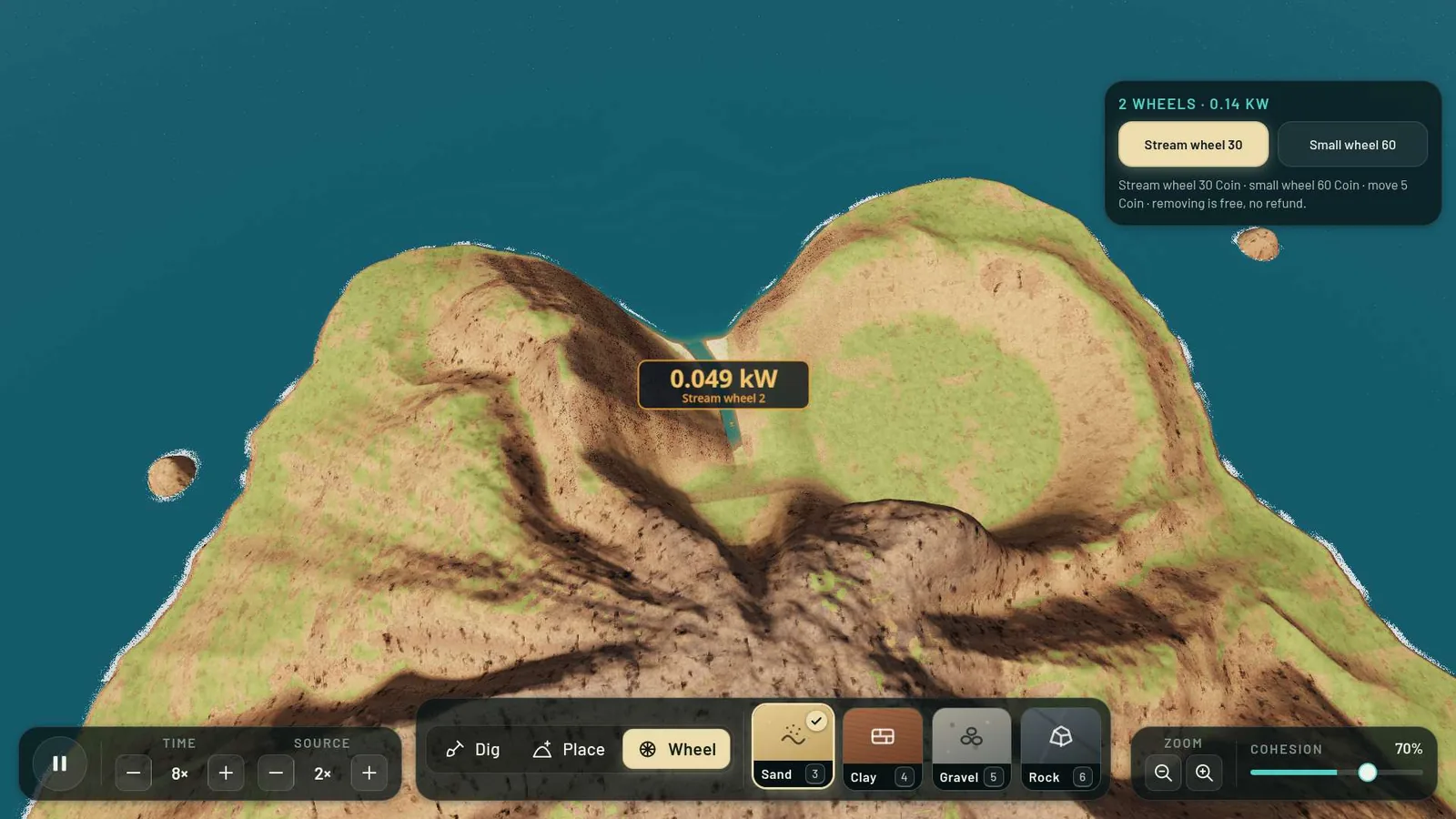
That meant the whole map had to be playable. Not a detailed patch that follows you around, with the rest of the island as scenery. Every part should support real digging, placing, water, and erosion. Quiet ground can rest until you disturb it. The island that grew out of that is about half a kilometre across, with room to grow later.
Make the water work
A river runs down to the sea from the moment the island loads. You can cut a step in the bed and set a water wheel in the flow. The fall of the water is what makes the power — a steeper drop matters more than a wide, lazy stream. On the untouched river a wheel makes only a little. Dig a step under it, and the output rises.
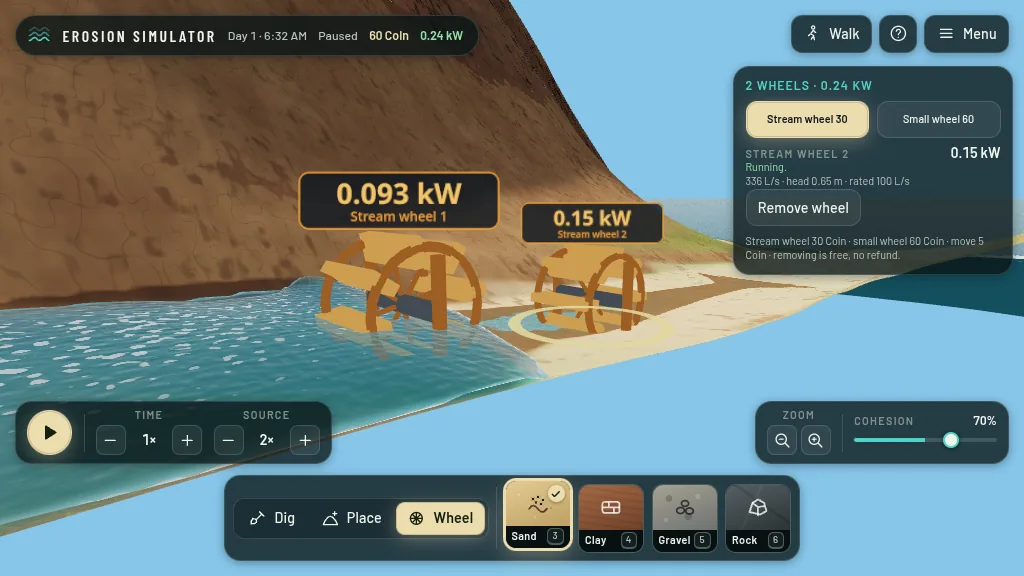
Wires and pylons carry that power to a substation at the edge of a small village. The town pays you in Coin for what you deliver, and you spend it on more work: another wheel, a stronger line, a bank you want to keep.
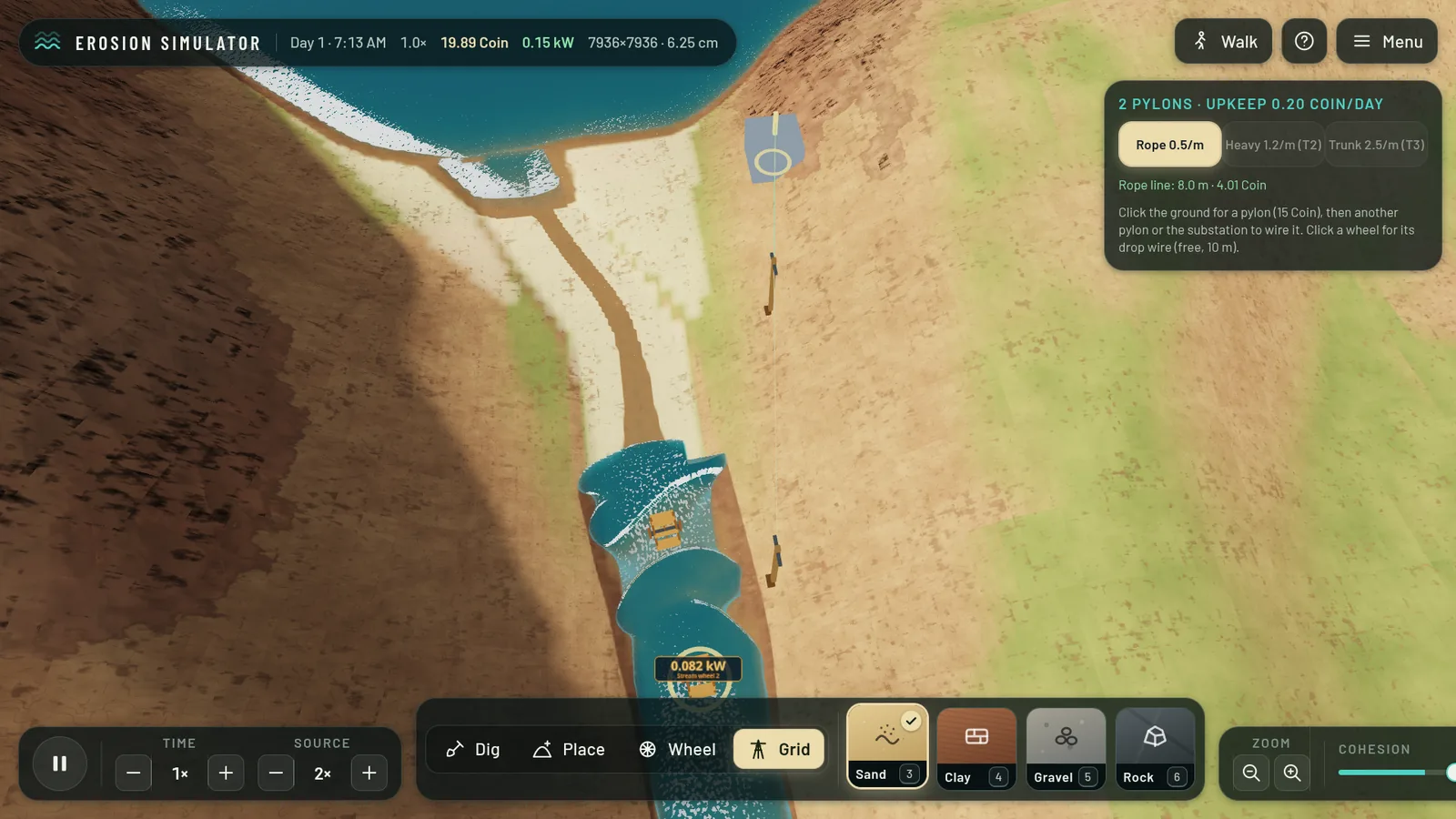
Water will also take it back. A pylon in a scoured channel will fall. Concrete can armour a footing or a bank so it will not wash away. Culverts let you carry a stream under a path or through a hill, instead of leaving a trench across it. Most of the game, as we see it now, is managing water so it does not destroy the things you built.
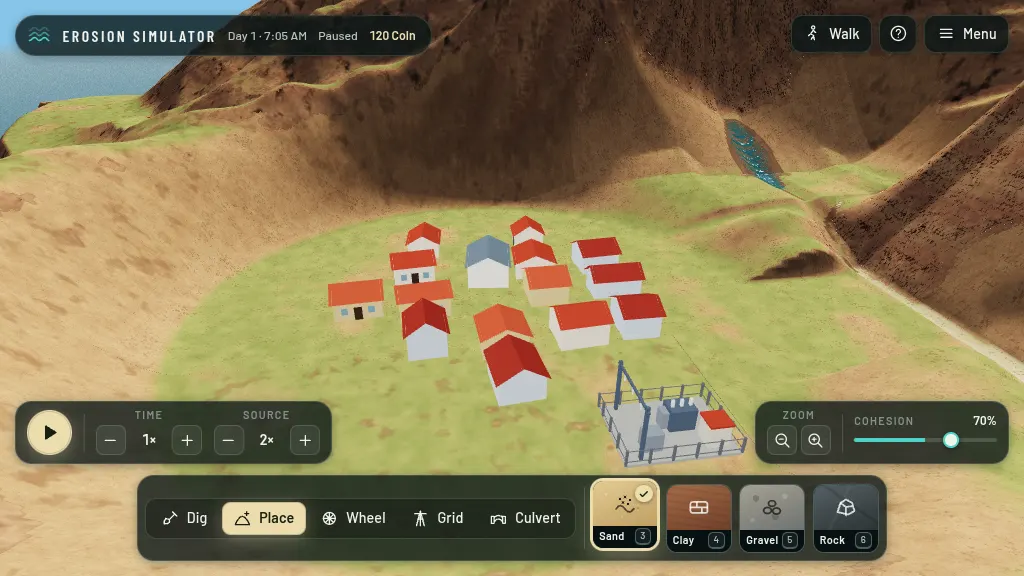
The village sits on a terrace above the stream, with the substation at its edge. Springs and wells will come later, for when the river is not enough. For now the built-in stream is the early water, and the loop is simple: shape the flow, make power, sell it, and spend what you earn to shape more.
How it's built
The way we make this is a little unusual, so we want to be plain about it.
There was no finished design document to start from. The developer describes what he wants — a dam that should actually erode, a whole island that can be shaped — and then plays each build. Grok Bot, an AI assistant, turns those descriptions into the game. It writes the code, runs the tests, and coordinates a small team of AI helpers. Those helpers take on programming, design, and performance testing on a few different home computers, using a high-end graphics card and a mid-range one, so we can see how the island feels on more than one kind of machine.
New builds are left beside the old ones, so a saved dam or an open tab is never thrown away just to try the next version. While he plays, he sends callouts: a bug, a wish, something that felt right. Fixes are gathered up and batched overnight, and the next morning there is something new to try.
That's the rhythm so far. The ideas and the playtesting are his. The building is done with Grok Bot in the middle of it.
We're not announcing a date. When there is something new to show, we'll write it here.